Why Football Became the World's New Religion

You can take away a man's gods, but only to give him others in return
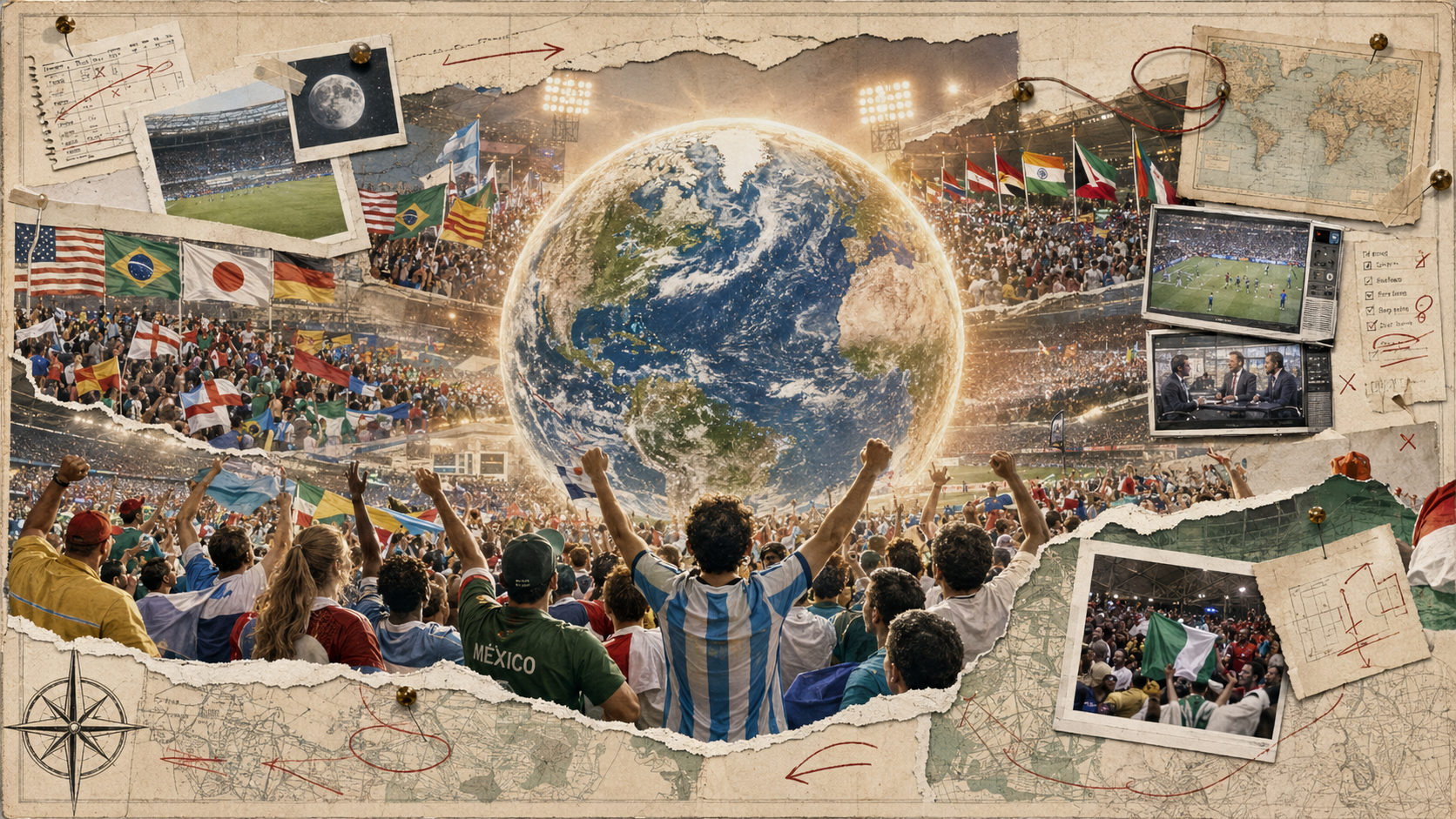
The World Cup is the largest shared spectacle on Earth. No religious festival, political event or single broadcast draws more of humanity's attention.
Millions travel across borders to attend and billions watch from their homes as eleven players carry the hopes of a nation onto the football pitch.
We call this sport, but psychologically, something much deeper is taking place.
Jung believed that the human psyche is naturally oriented towards something greater than the individual. When traditional religious forms collapse, the psychological energies once carried by them do not simply vanish. They migrate into politics, ideology, nationalism — and perhaps most visibly of all, football.
Football has its temples, rituals, songs, symbols, saints and sacrifices. It gives people identity, community and experiences of collective transcendence.
But it also raises a more troubling question: What happens when a game is asked to carry the spiritual weight once carried by religion? Perhaps football has not merely become the world's most popular sport, perhaps it has become the first truly global religion.
The Religious Impulse Never Disappeared
Human beings do not only search for pleasure, security or survival — they search for meaning. They seek communities that give them identity, and moments in which the boundaries of the individual self are dissolved into something greater. These needs do not disappear when belief in traditional religion declines. A person may stop attending church, but they do not stop searching for belonging.
Jung's point was not simply that people consciously choose something to believe in. He believed the psyche itself creates images of transcendence. Across cultures and throughout history, human beings have produced gods, myths, heroes and rituals. These patterns appear consistently because they express fundamental structures within the unconscious.
The religious impulse, in this sense, is not limited to belief in a particular doctrine. It is the tendency of the human mind to orient itself around something it experiences as ultimate. Something that gives order to chaos. Something that tells the individual who they are. Something that places suffering inside a larger story.
For centuries, God occupied that centre in much of the Western world. Religion gave people a symbolic framework through which suffering, sacrifice and death could be understood. It gave communities a shared language of meaning. But when God no longer occupies the centre of a culture, that centre does not remain empty. The psychological need remains. And when an old symbolic system loses its power, the energy once held within it begins to move elsewhere.
It may attach itself to politics. It may attach itself to nationalism. It may idolize individuals. And it may attach itself to football. Not because football is inherently deceptive or meaningless, but because it provides many of the forms through which the religious impulse has always expressed itself. It offers ritual, symbols, heroes and belonging. It gives the individual a larger identity into which they can temporarily dissolve.
The supporter does not merely watch a team. They become part of it. They speak of its history as their history. Its victories become their victories. Its losses become personal wounds. The group becomes more than an organisation. It becomes an inheritance, a community and a source of meaning.
This is why the decline of traditional religion does not necessarily create a less religious society. It may create a society that no longer recognises the religious nature of its own behaviour. The forms change, the language changes, the objects of devotion change — but the underlying impulse remains.
And in the modern world, few objects have attracted more collective devotion than football.
Why the World Cup Feels Greater Than Football
The World Cup reveals something that club football cannot fully contain. At club level, supporters identify with a city, a neighbourhood, a family tradition or an inherited community. But during the World Cup, football expands into something much larger. The team no longer represents only a club — it represents the nation.
The team's success becomes the collective success of an entire people, while its defeat can feel like a wound to the nation itself. This is why World Cup football produces emotions that seem disproportionate to the physical event. Because psychologically, something much larger is taking place.
The team becomes a container for national pride, historical grievance, collective insecurity, fantasies of superiority and memories of earlier humiliation. The match becomes a symbolic confrontation between nations. Old rivalries return. Political tensions enter the stadium. Colonial histories, wars and cultural resentments can reappear in disguised form through chants, commentary and public emotion. The pitch becomes a controlled theatre in which nations compete without directly going to war. A victory may therefore feel like more than sporting success — it can feel like vindication. It can seem to prove that the country is strong, respected and capable of standing alongside the great powers of the world. This becomes especially powerful for smaller nations or countries carrying memories of occupation, poverty, political marginalisation or international neglect. When such a nation defeats an established footballing power, the result can be experienced as the restoration of dignity. For a moment, the hierarchy of the world appears to reverse. A country that is usually ignored becomes impossible to ignore. Its flag is shown across the globe. Its players become symbols of national possibility. Its people feel seen. The victory says: We are here. We matter. We can defeat those who were supposed to be greater than us.
This is why one match can carry generations of emotion. It is never only about the result. It is about what the result appears to mean. The same process works in reverse. When a powerful footballing nation loses to a smaller opponent, the defeat may awaken shame. The public may speak of humiliation, disgrace or national decline. Players are accused of failing the country rather than simply losing a match. A sporting result becomes evidence in a much larger story about whether the nation is rising or falling.
The players are therefore asked to carry an impossible burden. They are expected not only to perform well, but to protect the collective self-image of millions. The individual athlete becomes the vessel into which an entire country pours its anger, disappointment and wounded pride.
From a Jungian perspective, this is projection on a national scale. The team carries contents that belong to the collective psyche. Hope, fear, insecurity and ambition are projected onto the players and then experienced through them. This is what gives the World Cup its mythic quality — heroes, villains, betrayals, sacrifices, miraculous returns and final judgments.
This is why the World Cup feels greater than football. It transforms a game into national mythology. The pitch becomes a stage upon which countries symbolically confront one another. The players become temporary embodiments of the nation. The supporter becomes part of a collective body. And the result becomes a story about identity, dignity and destiny.
When the final whistle is blown, the scoreboard records only who won and who lost. But the crowd experiences something else. The match becomes memory. The memory becomes legend. And the legend becomes part of the nation's story. The match becomes myth.
The Player as Hero, Saint and Saviour
Football does not merely produce successful athletes. It produces symbolic figures who appear to transcend the game itself. The exceptional player becomes a vessel for collective hope, ambition and identity — his life is gradually reorganised into the structure of myth.
Jung believed the hero was one of the recurring archetypal patterns of the human psyche. The hero represents the movement beyond limitation: the willingness to leave security, confront danger and struggle towards a more developed form of life. When these qualities are embodied by a footballer, supporters respond not only to the actual person, but to the psychological image he carries.
This is particularly significant for young men. Many encounter footballers at a stage of life when their own identity, social position and sense of possibility remain uncertain. The player appears before them as an image of recognised masculinity — strength, discipline, confidence, wealth, status and public admiration. He performs under pressure and receives public confirmation of his value. Through identification with the athlete, the young man can temporarily participate in a life that may feel unavailable within his own circumstances.
This identification becomes even stronger when the player shares the supporter's cultural, ethnic or national background. A child from an immigrant family may see a player with a similar name, appearance or history celebrated before the entire world. A young man from a neglected neighbourhood may watch someone who emerged from comparable conditions enter the stadium as a national hero. The player then becomes more than an individual success story. He embodies the unrealised potential of the group.
From a Jungian perspective, this is a form of projection. Qualities that exist as unrealised possibilities within the individual are experienced through an external figure. Courage, discipline, freedom, confidence and recognition appear to belong entirely to the player, while the supporter participates in them indirectly.
Projection is not necessarily harmful here. A heroic figure can awaken ambition and expand a young person's sense of what is possible. Representation can loosen the psychological boundaries imposed by class, race, poverty or social expectation. The player can become proof that inherited circumstances are not always final.
The danger arises when identification replaces personal development — when the psychological energy that might have gone toward the individual's own growth is transferred instead to the symbolic figure. This is where admiration develops into idolisation, and idolisation into deification. The player is no longer regarded as an exceptional but limited human being. He is elevated above ordinary humanity. His talent is described as supernatural. His arrival produces mass gatherings. His shirts are preserved, his boots displayed, objects associated with him treated as relics. He is called chosen, divine, immortal, a saviour, a footballing god.
Few players illustrate this process more clearly than Lionel Messi. He was not simply expected to perform well. He was expected to complete a national story. The question was not whether he was talented enough — it was whether he could save Argentina. The 2022 World Cup gave Messi's story the ending the mythology required. The hero returned for one final trial, endured uncertainty and lifted the trophy. Earlier failures were reinterpreted as necessary suffering. The return became redemption, and victory appeared as national deliverance. Within the collective imagination, Messi had not merely won a tournament. He had restored Argentina.
The title GOAT further intensifies this elevation. Though it stands for Greatest of All Time, psychologically it places the player beyond ordinary comparison — the standard against which every predecessor and rival must be measured. This resembles a form of secular canonisation. The player is fixed within collective memory and granted symbolic immortality.
This is why the idolisation of footballers resembles religious worship. It produces chosen figures, stories of suffering and redemption, communities of followers and moments of collective exaltation.