Christ as the Archetype of the Self

Our discourse necessarily brings us to Christ, because he is still the living myth of our culture. Christ exemplifies the archetype of the Self.
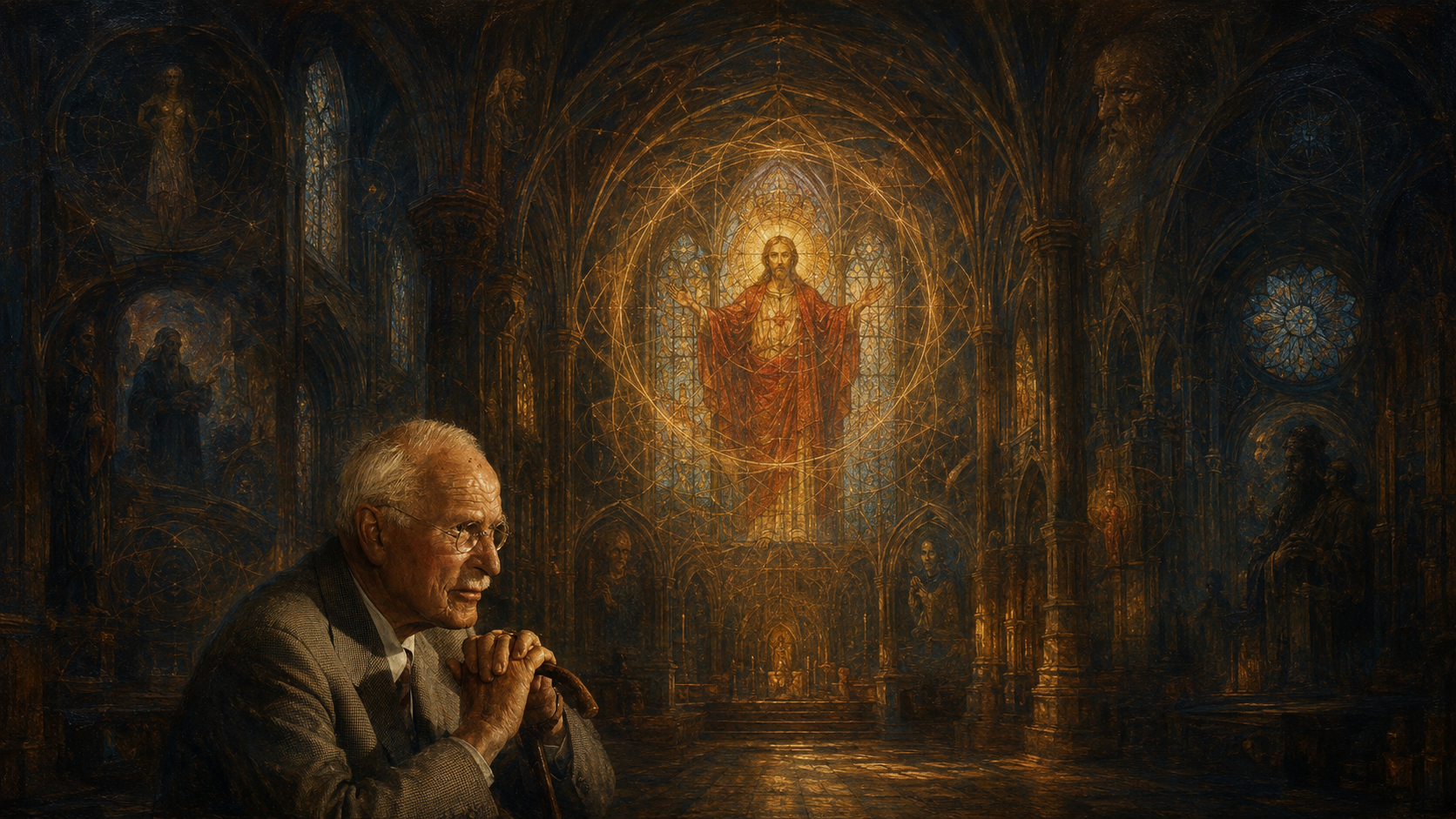
For nearly two thousand years, the image of Christ has stood at the symbolic centre of the Western world. His life has been painted across cathedral walls, retold in literature and embedded in the imagination of entire nations.
Ideas such as sacrifice, redemption and the transformation of suffering have found some of their most enduring expressions through the figure of Christ.
Even in a time where Christian belief has declined, the symbolic world formed around Christ has not disappeared. Its language, moral assumptions, and imagery continue to shape how the West understands justice, mercy, and human worth.
This was no historical accident in Jung’s view.
He believed the extraordinary influence of Christ pointed toward something far deeper than cultural tradition. It revealed one of the deepest structures of the human psyche.
For Jung, Christ was the living symbol through which Western civilisation expressed the psychological wholeness he called the Self.
The Self is not the ego. It is the totality of the personality: conscious and unconscious, known and unknown, individual and universal. It is the deeper organising centre around which the fragmented elements of the person gradually become integrated.
While the life of Christ certainly follows the pattern of the archetypal hero—confrontation with evil, suffering, sacrifice, death, and resurrection—for Jung, Christ represents something greater.
He represents the wholeness toward which that transformation ultimately points.
Christ as the Archetype of the Self
To understand why Jung connected Christ with psychological wholeness, we must first distinguish between the ego and the Self.
The ego is the centre of conscious identity. It is the personality we recognise, the history we remember, the values we consciously affirm and the image we present to the world.
But the ego is only one part of the psyche.
Beyond it lies the unconscious, containing instincts, memories, emotions and possibilities that have never been fully admitted into conscious life. Some were forgotten. Others were repressed because they conflicted with the personality we wished to maintain.
The person we consciously believe ourselves to be is therefore always incomplete.
The ego constructs a coherent account of who we are, but that account rarely contains the whole truth.
This is why an identity built exclusively around status can collapse when status is lost. If a person has come to believe that they are their career, reputation or social position, then failure does not merely remove something they possess. It threatens the entire structure through which they understand themselves.
Jung believed psychological development requires us to move beyond this narrow identification with the ego. This movement is what he called individuation.
The persona must be recognised as a social mask rather than mistaken for the whole person. The shadow must be confronted rather than projected onto others. Instinct, emotion, conscience and unconscious imagery must be brought into a meaningful relationship with conscious life.
For Jung, this movement toward greater wholeness is directed by the Self.
The Self is not simply a perfected version of the ego. It represents the entire personality, conscious and unconscious together. Jung described it as both the centre and the circumference of the psyche: the deeper organising principle that contains the ego while also extending beyond it.
The ego experiences itself as the centre of life.
The Self confronts it with the fact that it is not.
This is why encounters with the Self can carry a religious quality. The individual experiences something within the psyche that feels greater than conscious intention—something that challenges, judges and reorganises the ego rather than merely serving it.
The Self therefore functions as an inner image of totality, but also as an authority beyond the limited perspective of consciousness.
It is here that Christ becomes central to Jung.
Within the Christian image, the human and divine meet in a single figure. Authority appears through humility. Victory is achieved not through domination but through sacrifice. Suffering is neither avoided nor treated as meaningless; it becomes the means through which transformation occurs.
Christ does not conquer by remaining untouched by darkness, he enters betrayal, abandonment, humiliation and death.
Transformation comes through the willing passage into suffering rather than the refusal to experience it.
This gives the life of Christ the recognisable structure of the archetypal hero. He receives a vocation, confronts temptation, enters conflict with evil, suffers, dies and returns transformed.
But Jung’s interpretation does not end with the hero.
The hero usually represents the developing ego struggling against chaos. The heroic journey depicts separation from the familiar world, confrontation with danger and the emergence of a stronger consciousness.
Christ, as a symbol of the Self, represents something greater than the victorious ego.
He represents the totality toward which the heroic struggle is directed.
The difference is subtle but important.
The hero overcomes an enemy.
Christ accepts a sacrifice that transforms the meaning of defeat itself.
The hero may return stronger.
Christ’s resurrection presents life emerging through death.
The hero often establishes identity through conquest.
Christ relinquishes worldly power while embodying an authority that cannot be reduced to political domination.
For Jung, these patterns gave Christ an unparalleled psychological significance within Western civilisation. His image brought together realities the conscious mind frequently attempts to separate: strength and submission, individuality and universality, suffering and redemption, mortality and eternal significance.
The figure of Christ therefore offered the Western psyche an image of a personality organised around something greater than self-preservation.
This is particularly visible in the voluntary acceptance of suffering.
Ordinarily, the ego interprets suffering as an interruption to the life it believes it should possess. It responds through avoidance, resentment or the attempt to regain control.
Yet some forms of development are impossible without suffering.
Suffering does not automatically make a person whole. It can equally produce bitterness and fragmentation.
Its psychological value depends partly upon the attitude taken toward it.
The image of Christ presents suffering not as inherently good, but as something that can be consciously borne, given meaning and transformed through relation to a higher purpose.
The cross therefore becomes more than an image of pain. Psychologically, it represents the point at which the ego’s desire for control, recognition and self-preservation is surrendered to a reality greater than itself.
This helps explain why Jung saw Christ as more than a moral teacher.
A moral teacher offers principles for conduct.
An archetypal image embodies a pattern of transformation.
Christ does not merely instruct the individual to become humble, courageous or self-sacrificing. His life gives symbolic form to the death of an old orientation and the emergence of a new one.
For Jung, the authentic encounter with the Christ-image should not inflate the ego through identification with goodness. It should humble the ego by confronting it with a standard and a totality greater than itself.
This is the deeper meaning of Christ as an archetype of the Self.
Christ represents the possibility that the fragmented personality might be reorganised around a centre beyond immediate desire, social status and conscious self-image.
He embodies transformation through sacrifice, a life directed by vocation rather than impulse, and an identity capable of passing through suffering without being reduced to it.
Jung’s insight was that Christ had become the supreme image through which the Western psyche imagined wholeness.
The Power of Words
If Christ represents psychological wholeness, we are immediately confronted with another question.
How does such transformation actually take place?
One answer appears so ordinary that we often fail to recognise its significance.
It takes place through words.
At first glance, this seems almost trivial.
A spoken word is little more than air passing through the vocal cords. A written word is nothing more than ink on paper or pixels on a screen. Their physical properties are remarkably insignificant.
And yet, words possess an extraordinary ability to shape the course of a human life.
This is because human beings do not respond merely to sounds or symbols.
We respond to what those sounds and symbols mean.
In this sense, words are not merely vehicles of communication.
They are one of the primary means through which the psyche is formed.
Consider the life of a child.
A child is not born with a fully developed understanding of who they are or what the world is like. Those understandings are gradually formed through countless interactions with parents, family, teachers and the wider environment.
If a child repeatedly hears that they are loved, capable and valued, those words communicate far more than encouragement. They become part of the child's developing understanding of themselves.
Conversely, imagine a child who repeatedly hears:
"You're useless."
"You'll never amount to anything."
"You're a disappointment."
The physical sound of those words disappears within seconds.
But their meaning may remain for decades.
Gradually, those statements cease to feel like opinions expressed by another person and they become the child's own understanding of reality.
The child no longer thinks:
"My father told me I was worthless."
Instead, they experience:
"I am worthless."
The belief has moved beyond conscious reflection and has become part of the psychological framework through which the individual interprets themselves.
The same process shapes our understanding of the world itself.
A child raised in a secure environment often develops an unconscious expectation that the world is fundamentally safe, that relationships can be trusted, and that failure does not destroy personal worth.
A child exposed to chronic abuse, neglect or unpredictability may develop a very different psychological landscape.
The world becomes dangerous.
Other people become potential threats.
Love becomes something fragile or conditional.
Again, these are not merely intellectual opinions.
They become unconscious assumptions through which every future experience is interpreted.
Two people may therefore encounter exactly the same event and experience it in entirely different ways because they are not responding only to the event itself.
They are responding through the psychological structures that have already been formed within them.
Importantly, this process does not remain confined to the realm of thought.
Modern neuroscience has demonstrated that the brain continually adapts to repeated patterns of experience, a process known as neuroplasticity.
Repeated thoughts strengthen particular neural pathways.
Repeated emotional responses become increasingly familiar.
Repeated behaviours gradually become habits.
Because the meanings carried by words influence attention, expectation, emotion and behaviour, and the brain continually adapts to those repeated patterns.
The immaterial begins to shape the material.
This process does not end in childhood.
It continues throughout life.
Consider an emotionally abusive relationship.
The abuse often begins long before physical violence.
A partner repeatedly says:
"You're overreacting."
"Nobody else would love you."
"You're imagining things."
"This is your fault."
Each statement may appear insignificant when viewed in isolation.
Yet over months or years they can gradually erode a person's confidence in their own judgement.
The victim begins to question their own perceptions.
They become increasingly dependent upon the abuser's interpretation of reality.
Eventually, they may defend the very person causing the harm because the false narrative has become psychologically internalised.
Nothing material has entered the body except words.
Yet the individual's identity, emotional life, relationships and patterns of behaviour have all begun to reorganise around meanings that are fundamentally false.
Again, the brain reflects this process.
Heightened vigilance becomes habitual.
Stress responses become easier to trigger.
Patterns of fear, anxiety and avoidance become increasingly automatic.
The psychological framework established through language is gradually embodied within the nervous system itself.
The immaterial continues to shape the material.
This is why words possess such extraordinary power.
They do not merely communicate information.
They organise perception.
They shape belief.
They influence identity.
They alter behaviour.
And over time, they leave their mark upon the very structure of the brain.
This observation sits remarkably comfortably alongside Jung's psychology.
Jung believed that much of psychological suffering arises because individuals unknowingly organise their lives around unconscious assumptions, complexes and symbolic structures they mistake for reality itself.
The task of analysis is not simply to recover forgotten memories.
It is to make those hidden structures conscious, allowing them to be examined in the light of truth rather than unconsciously directing the person's life.
Against this background, one feature of Christ's ministry becomes particularly striking.
Christ performed miracles.
He healed the sick.
He confronted injustice.
Yet the overwhelming majority of His ministry consisted of something far quieter.
He spoke. He taught. He challenged assumptions.
He corrected false understandings of God, of humanity and of the individual.
Again and again, He addressed the meanings through which people understood reality.
This gives remarkable depth to one of His statements recorded in John's Gospel:
Whether one approaches those words psychologically or theologically, they invite a profound question.
If words possess the capacity to shape the human psyche, reorganise belief, influence the brain and transform behaviour...
What distinguishes words that give life from words that produce fragmentation?
Christ and the Unconscious
If words possess the capacity to shape the human psyche, then Christ's ministry appears in a very different light.
He is often remembered as a moral teacher, yet the Gospels repeatedly show Him doing something more profound than simply instructing people how they ought to behave. Again and again, Christ speaks to hidden assumptions, concealed motives and deeply rooted identities that the individual has not yet recognised within themselves.
This raises an intriguing psychological question.
How well do we really know ourselves?
For Jung, this question lies at the very heart of psychology. He believed the ego mistakes itself for the whole personality. We naturally identify with the conscious image we have of ourselves—our values, intentions and self-understanding. Yet beneath consciousness lies a far larger psychological reality containing fears, desires, instincts, memories and conflicts that continue to influence behaviour without our full awareness.
The task of psychological development is therefore not simply to become more knowledgeable, but to become more conscious. It is to discover that much of what directs our lives operates outside the narrow field of conscious awareness.
When we read the Gospels through this psychological lens, something remarkable begins to emerge.
Christ repeatedly demonstrates an understanding of the human person that extends beyond what people consciously know about themselves.
One of the clearest examples is Peter.
On the night before the crucifixion, Peter confidently assures Christ that his loyalty will never fail. Even if everyone else abandons Him, Peter insists that he will remain faithful.
There is no reason to doubt Peter's sincerity.
He genuinely believes what he is saying.
Yet Christ responds by telling him that before the rooster crows, he will deny Him three times.
Peter cannot accept this. His understanding of himself simply does not allow for such a possibility. The image he has constructed of his own courage is so complete that Christ's words appear impossible.
Only hours later, however, Peter does exactly as Christ predicted.
Psychologically, this moment is extraordinary.
Peter is not consciously deceiving Christ.
He is deceived about himself.
He speaks from the conscious image he has formed of his own character, while Christ sees a deeper reality that Peter has not yet encountered.
Only after the denial does Peter begin to understand the distance between who he believed himself to be and who he actually was under the pressure of fear.
This distinction lies at the heart of Jung's psychology.
The conscious personality often presents an incomplete picture of the individual. Genuine transformation begins when that image is disrupted and the person is forced to confront aspects of themselves they had previously denied, ignored or simply never recognised.
Peter's denial becomes precisely such a moment.
His confidence collapses.
His self-image is shattered.
But in its place emerges the possibility of a more truthful understanding of himself.
The same psychological insight appears again during the crucifixion.
As Christ hangs upon the cross, He says:
These words are rightly remembered as one of history's greatest expressions of forgiveness.
Yet they also contain a profound insight into human nature.
Christ suggests that people are capable of acting without fully understanding the forces that move them.
Their actions arise from fear, pride, social pressure, resentment and spiritual blindness that they themselves do not completely perceive.
"They know not what they do."
This does not imply that human beings lack intelligence or moral responsibility.
Rather, it recognises that self-knowledge is often incomplete. We frequently understand our actions only at the level of conscious intention while remaining unaware of the deeper motives that influence them.
Here the parallel with Jung becomes particularly striking.
Jung argued that much of human behaviour originates in unconscious psychological processes. People often believe they are acting freely while remaining influenced by unresolved fears, projections, emotional complexes or unconscious identifications.
Although the well-known statement, "Until you make the unconscious conscious, it will direct your life and you will call it fate," is a later paraphrase rather than a direct quotation, it accurately captures one of the central themes running throughout Jung's work.
The unconscious influences the individual long before the individual becomes aware of it.
Christ's encounters with people throughout the Gospels reveal a remarkably similar pattern.
He repeatedly exposes the hidden condition beneath outward behaviour.
He confronts religious leaders whose apparent righteousness conceals pride and hypocrisy.
He reveals fear beneath Peter's confidence.
He exposes self-righteousness beneath legalism.
He uncovers despair beneath the lives of those who believed themselves beyond redemption.
Again and again, Christ directs His attention beyond behaviour to the condition of the heart from which behaviour arises.
This is what makes His words psychologically distinctive.
They do not merely prescribe moral conduct.
They reveal the person to themselves.
They expose false identities before offering a new one.
They uncover hidden assumptions before inviting the individual into a different understanding of God, of others and of themselves.
Whether one approaches these passages psychologically or theologically, they suggest that genuine transformation cannot begin while a person remains imprisoned by an illusion about who they are.
Truth does not merely comfort.
It first reveals.
It brings into consciousness what has long remained hidden.
Only then can the person begin to change.
Perhaps this is why Christ repeatedly connects truth with freedom.
Before truth can transform the individual, it must first expose the falsehoods through which they have unknowingly lived.
I Am the Truth and the Life
When Christ says, “I am the truth and the life,” He makes a claim that extends far beyond factual accuracy.
Psychologically, truth is that which brings the individual into a more honest relationship with reality, including the reality of themselves.
This matters because falsehood does not remain confined to thought. A child who comes to believe they are worthless may organise their entire personality around that belief. They may distrust affection, expect rejection and interpret failure as confirmation of what they already assume to be true.
The belief is false, but its consequences are real.
Truth therefore does more than correct information. It exposes the false meanings around which a life has been organised.
This is one of the central aims of Jung’s psychology. The ego believes it knows who it is, yet much of the personality remains unconscious. Fear may hide beneath confidence. Resentment may disguise itself as moral certainty. Pride may appear as righteousness. Psychological development begins when these hidden motives are brought into consciousness.
Christ repeatedly does this in the Gospels. He does not address only outward behaviour. He reveals the condition beneath it.
Peter believes himself incapable of betrayal, yet under pressure he denies Christ three times. His conscious intention is sincere, but his self-knowledge is incomplete. The denial destroys an idealised image of himself, but it also creates the possibility of a more truthful identity.
This fuller understanding of the human person also gives radical forgiveness greater psychological coherence.
If we reduce someone entirely to their worst action, forgiveness appears to deny reality. But every action emerges from a person shaped by conscious intention, unconscious fear, inherited patterns and motives they may only partially understand.
This does not remove responsibility.
It makes judgement more humble.
When Christ says from the cross, “Father, forgive them, for they know not what they do,” He does not deny the evil being committed. Those crucifying Him know what they are doing at one level, but they do not fully understand the fear, group pressure, resentment and spiritual blindness directing them.
They understand the action.
They do not understand the whole of what moves them.
Forgiveness, then, is not the refusal to name evil. It is the refusal to reduce the whole person to the evil they have committed.
It also protects the wounded person from allowing that evil to become the organising centre of their own psyche. Resentment can bind a person internally to the one who harmed them. Forgiveness does not change the past, but it can prevent the past from possessing the whole personality.
This is why truth and life belong together.
Falsehood divides the person from reality. Truth may initially wound the ego, but it makes integration possible. Weakness can be acknowledged without becoming worthlessness. Guilt can be faced without becoming permanent condemnation. Suffering can be recognised without being allowed to define the whole person.
Jung believed that wholeness requires an increasingly truthful relationship with both conscious and unconscious life.
Christianity goes further.
It identifies the final ground of that truth with Christ Himself.
From a Jungian perspective, Christ reveals the image of wholeness.
From the Christian perspective, He is the truth through which the person is restored to life.