
Shadow Work: Carl Jung's Five-Step Guide to Psychological Integration

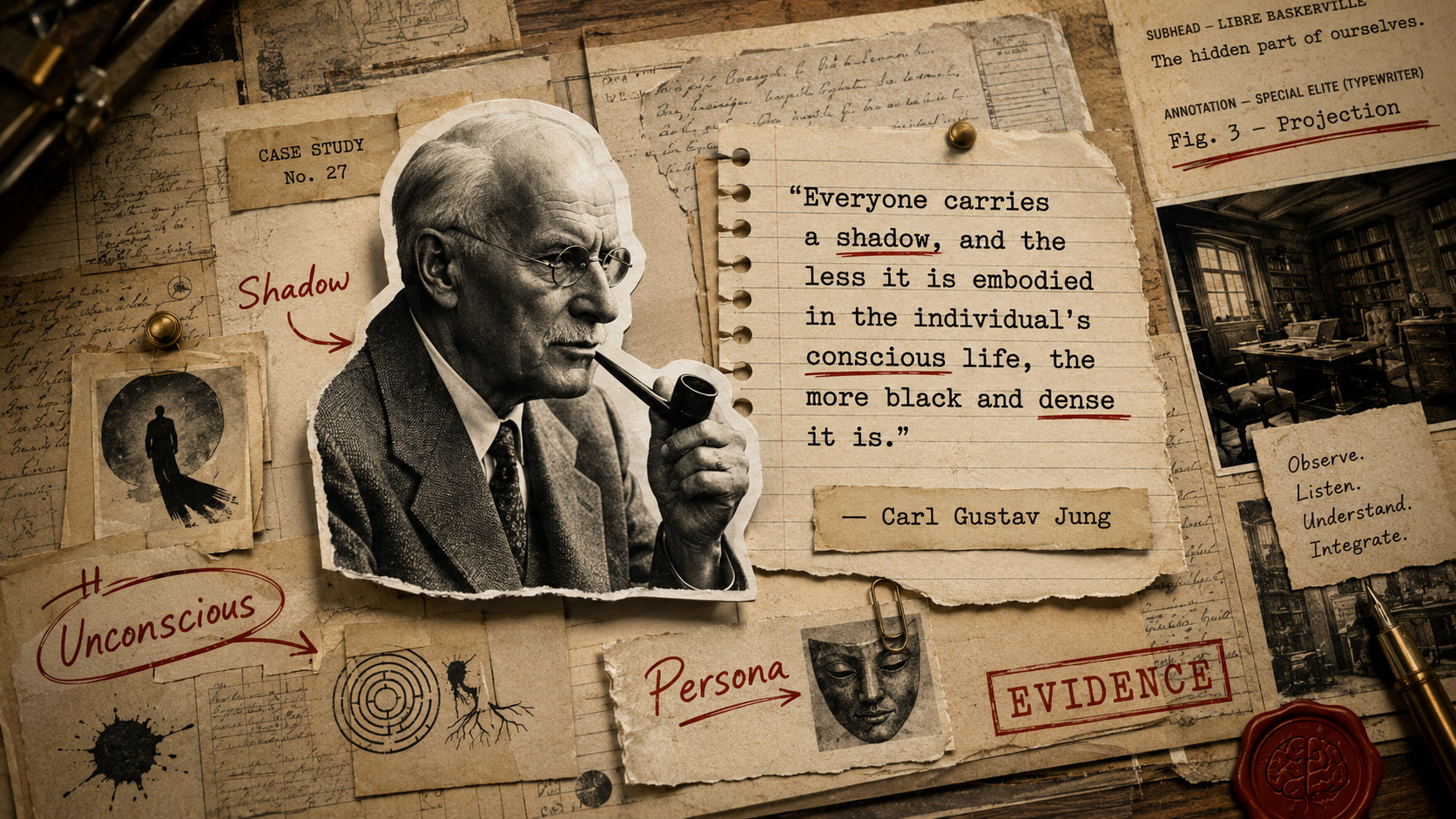
Everyone carries a shadow, and the less it is embodied in the individual’s conscious life, the more black and dense it is
In Jung’s model, the shadow is a precise psychological structure: the sum of everything the conscious mind has refused to own — traits, impulses and desires that got labelled unacceptable and were pushed out of awareness rather than dealt with.
It can hold cruelty and rage, but it just as easily holds ambition, creativity and sensitivity.
Shadow work is not about eliminating darkness from the personality.
It is the process of becoming conscious of the traits, emotions, desires and capacities that the ego has rejected. What remains unconscious does not disappear. It continues to influence our reactions, relationships and decisions from beneath awareness.
The purpose of shadow work is therefore not to become morally perfect. It is to become less divided, less reactive and more responsible for what lives within us.
Step 1: Observe Your Reactions and Behaviour
The first step in shadow work is learning to recognise where the shadow appears.
One of the clearest places it reveals itself is in our reactions to other people.
We often assume that our reactions are caused entirely by the person in front of us. Yet there are moments when the intensity of our response far exceeds the event itself, suggesting that something deeper has been stirred within us. For example, a person's confidence may irritate us because we have learned to suppress our own. A person's success may awaken an ambition we abandoned. A compliment may make us uncomfortable because accepting it would challenge the image we have formed of ourselves.
In these moments, the other person may not simply be the cause of the reaction. They are the catalyst that reveals something already present within us. This is what Jung referred to as projection.
Projection causes us to experience unconscious aspects of ourselves as though they exist primarily in other people. For this reason, the people we admire most intensely and the people we condemn most fiercely often become mirrors through which the shadow becomes visible. Learning to recognise these moments is one of the first signs that unconscious material is entering awareness. Another way we can identify the shadow is through our own repeated and compulsive behaviour.
Whether it is alcohol, substances, work, social media or something else, we often find ourselves returning to the same patterns despite knowing they conflict with the person we consciously believe ourselves to be. At this stage, it is not necessary to explain these behaviours or understand why they occur. The task is simply to notice them.
Judgment often drives unwanted thoughts and impulses further underground. Observation brings them into consciousness. Over time, patterns begin to emerge. We notice what repeatedly provokes us, what repeatedly captures our attention, what we habitually avoid and which behaviours we return to again and again. These patterns remind us that the conscious self is only one part of the personality. Much of what we think, feel and do is influenced by processes operating beyond conscious awareness.
Shadow work therefore begins not with changing ourselves, but with seeing ourselves more clearly. Before the shadow can be understood or integrated, it must first be brought into consciousness. You cannot integrate what you refuse to see.
Step 2: Listen to the Shadow
Once the shadow has been observed, the next step is not to resist or dismiss it, but to listen. Our instinct is often to justify the reaction, suppress it or distract ourselves from it. Yet in doing so, we silence the very part of the psyche we are trying to understand.
The shadow does not become conscious because we argue with it. It becomes conscious because we are willing to hear what it has to say. This does not mean accepting every thought as true or acting on every impulse. Thoughts can be distorted, emotions can be misleading and impulses can be destructive. The goal is not to obey the shadow, but to understand what it is trying to communicate. Every recurring emotion, persistent reaction and compulsive pattern is attempting to draw our attention to something that has not yet been fully acknowledged.
Anxiety may be pointing toward a fear we have avoided. Anger may reveal a boundary that has repeatedly been crossed. Jealousy may expose an unrealised potential or an unlived ambition. Even a compulsive behaviour may be expressing a need that has never been consciously recognised.
Rather than asking, "How do I get rid of this feeling?" begin by asking, "What is this feeling trying to show me?"
That small shift changes our relationship with the unconscious. Instead of seeing uncomfortable emotions as problems to eliminate, we begin to approach them with curiosity. We stop asking how to silence the messenger and start asking why the message has appeared.
This does not mean every message is true, but every message is worth understanding before it is judged. Only when we learn to listen can we begin to understand what the shadow is actually saying.
Step 3: Discover the Root
Once we have learned to observe the shadow and listen to what it is trying to communicate, the next step is to understand where it came from.
The patterns we experience rarely appear without cause. Every recurring fear, emotional reaction, insecurity or compulsive behaviour has a history. The question is no longer simply, What am I experiencing? but, Why has this become part of my personality? Some aspects of the shadow are deeply personal.
A fear of rejection may develop through painful relationships. Difficulty accepting praise may stem from growing up in an environment where confidence was discouraged. A tendency to avoid conflict may have been learned in a household where expressing emotion led to criticism or instability.
Over time, we adapt to our environment. We learn which parts of ourselves are accepted and which are rejected. The qualities that threaten our relationships, our identity or our sense of safety are often pushed outside conscious awareness. In this way, the shadow becomes shaped by our own life story.
But not every aspect of the shadow is formed through personal experience. Some parts of it are inherited from the families, communities and cultures in which we are raised. A boy may learn that showing emotion is weakness. A girl may learn that being assertive is unfeminine. Someone may grow up believing that ambition is selfish, vulnerability is failure or forgiveness is naïve. Over time, these beliefs become so deeply embedded that they no longer feel like ideas we have inherited. They feel like objective truths. We reject parts of ourselves not because they are inherently wrong, but because we have been taught they are unacceptable. This is what we might think of as the collective shadow—those aspects of human nature that families, cultures and societies themselves struggle to acknowledge.
But there is another source of the shadow that reaches even deeper. Not every aspect of the shadow is acquired through personal experience or social conditioning. Some elements belong to our shared human nature. Every person possesses the capacity for anger, lust, envy, pride, fear and aggression. These instincts are not evidence that something has gone wrong. They are part of the psychological inheritance of being human. The danger is not that these impulses exist. The danger is pretending that they do not.
What remains unconscious does not disappear. It simply finds another way to express itself. This was one of Jung's most important insights. The person who believes they are incapable of hatred is often the one most easily consumed by it. The person who insists they could never deceive, manipulate or seek revenge may simply fail to recognise those tendencies when they arise. The shadow gains its power through denial. Discovering the root of the shadow is therefore not about assigning blame to our parents, our culture or even our biology. Nor is it about excusing destructive behaviour.
It is about understanding the forces that have shaped us so that we are no longer governed by them unconsciously. The purpose of shadow work is not to erase our past, reject our humanity or become someone else. It is to distinguish between what we have inherited, what we have learned and what we consciously choose to become.
Step 4: Respond Consciously
By this stage, you have observed the shadow, listened to what it is communicating and begun to understand where it came from.
The next step is to change your relationship with it.
For most of our lives, the shadow operates automatically. A situation arises, an emotion appears and we react before we have even realised what has happened. The unconscious impulse becomes conscious behaviour.
Shadow work is the practice of interrupting that process.
Between the impulse and the reaction there is a moment of choice. At first, that moment may be almost impossible to notice. But as awareness grows, so does the space between what we experience and how we respond.
Within that space, we discover something we did not previously have:
Freedom.
Instead of immediately identifying with the emotion, we learn to observe it.
Rather than saying, "I am angry," we begin to recognise, "Anger is arising within me." Instead of, "I am jealous," we notice, "Jealousy is present."
This may seem like a subtle difference, but psychologically it is profound.
The emotion is no longer your identity. It is an experience moving through your consciousness.
The same is true of the thoughts that accompany it.
The shadow often speaks with great certainty. It tells us that we are worthless, that we are superior, that we have been rejected, that we must retaliate or that we can never change. Left unexamined, these thoughts feel like objective truth.
But a thought is not a fact, and an impulse is not a command. The goal is not to suppress these thoughts or pretend they do not exist. It is to recognise them without allowing them to determine who we become.
Every time we pause before reacting, we loosen the grip of the unconscious.
Every time we choose awareness over impulse, we strengthen the conscious personality.
This is where responsibility begins.
Not because the shadow disappears, but because we are no longer completely identified with it.
Shadow work is therefore not about eliminating darkness.
It is about becoming conscious enough that darkness no longer determines our actions without our awareness.
The more conscious we become, the greater our freedom becomes.
And it is within that freedom that genuine transformation begins.
Step 5: Integrate the Shadow
Shadow work does not end with understanding.
Insight alone is not transformation.
It is possible to recognise our patterns, understand where they came from and even identify the voice of the shadow, yet continue living exactly as before.
Integration begins when awareness becomes action.
Every time we pause before reacting, choose honesty over denial or respond consciously rather than automatically, the relationship between the conscious and unconscious begins to change.
The shadow does not disappear.
It becomes something we recognise rather than something that unconsciously governs our lives. This process requires patience.
Many of the patterns we carry have developed over years, sometimes decades. They will not disappear after a single moment of insight. Psychological growth is gradual. It is measured not by perfection, but by increasing awareness and increasingly conscious choices. It also requires humility.
The shadow is not something we conquer once and for all. It is something we continue to encounter throughout our lives. The moment we become convinced that we are beyond pride, anger, lust, envy or self-deception, we become vulnerable to them once again.
But perhaps most importantly, integration requires faith. For those struggling with addiction or compulsive behaviour, the greatest obstacle is often not the behaviour itself, but the shame that follows it.
The cycle is painfully familiar. The impulse arises, we give in to it, experience temporary relief and then the shame arrives. Over time, the shame becomes part of the addiction itself.
We begin to believe that because we continue to fail, we are failures.
That because we struggle with lust, anger, addiction or envy, that is who we truly are. But this is precisely the illusion that shadow work seeks to overcome.
The shadow is not your identity.
It is a part of your personality that has not yet been fully understood or integrated.
Shame turns behaviour into identity. Faith keeps transformation possible.
Progress is rarely linear.
There will be setbacks. Old patterns will return. The shadow will sometimes feel stronger than your conscious intentions.
Do not mistake these moments for failure.
Every moment of awareness is evidence that consciousness is growing. Every time you recognise the pattern before acting on it, you have already weakened its unconscious hold.
This is why Jung described individuation not as a destination, but as a lifelong process. We are never finished.
Life continually reveals new aspects of ourselves through new relationships, new responsibilities and new challenges.
The goal is therefore not to become perfect. Nor is it to eliminate every dark impulse from the personality.
The goal is to become whole. To recognise the capacity for both light and darkness within yourself.
To accept responsibility for both.
And, with patience, humility and faith, to consciously choose which one will shape the person you become. Shadow work is not the process of becoming someone else. It is the process of becoming the fullest, most honest and most conscious version of who you already are. Only then can the shadow cease to govern your life from the darkness and become a part of yourself that has been acknowledged, understood and brought into the light.