
Carl Jung on God, Transcendence, and the State

Jung believed that one of the defining characteristics of the human psyche is its orientation toward the transcendent. The question, he argued, is not whether human beings will devote themselves to something greater than themselves, but what that 'something' will be. Across his writings, he repeatedly argued that while psychology cannot prove God's metaphysical existence, it cannot dismiss the profound psychological reality of religious experience or the role it has played throughout human history.
The argument extends far beyond private spirituality. He believed that human beings require a transcendent frame of reference and a moral orientation capable of relating consciousness to the unconscious, good to evil, and the individual to realities greater than the ego itself. This conviction lies at the heart of his psychology, from his understanding of the transcendent function to his insistence that genuine psychological development demands what he called a "mental and moral attitude" toward the unconscious.
From this, Jung drew a profound conclusion. If religion is reduced to mere doctrine or dismissed by rationalism, the religious function itself does not disappear. It simply seeks another object. In modern society, he warned, that impulse can become attached to ideology, nationalism, political movements, or even the State itself. His concern was therefore not simply religion versus atheism, but whether the symbolic and moral centre of gravity remains rooted in the individual's relationship to a higher order, or is absorbed by the collective.
The Psychological Reality of God
Jung repeatedly insisted that psychology cannot determine whether God objectively exists. The psychologist cannot place God under a microscope, nor can he prove or disprove the metaphysical claims of religion.
What psychology can study, however, is something equally significant: the effect that belief in God has upon the human psyche. Throughout his career, Jung became increasingly convinced that the image of God occupies a unique place within human consciousness. He referred to this as the God-image—not as a statement about God's objective existence, but as the psychological representation through which human beings encounter ultimate meaning.
This distinction is crucial.
When Jung speaks of the God-image, he is not reducing God to a mere invention of the mind, nor claiming that psychology has disproved religion. He is simply distinguishing between psychological experience and metaphysical reality. By remaining within the limits of his discipline, Jung was able to take religious experience with complete seriousness without making claims that psychology itself could neither prove nor disprove.
For Jung, religion was therefore far more than a collection of doctrines or inherited traditions. He defines it as an attitude toward the transcendent—a reality experienced as greater than oneself, capable of seizing the individual and transforming consciousness. Religious creeds, he argued, are often the institutional expressions of experiences that originally emerged from direct encounters with this transcendent reality.
This explains why Jung devoted so much attention to myths, dreams, symbols, and sacred texts.
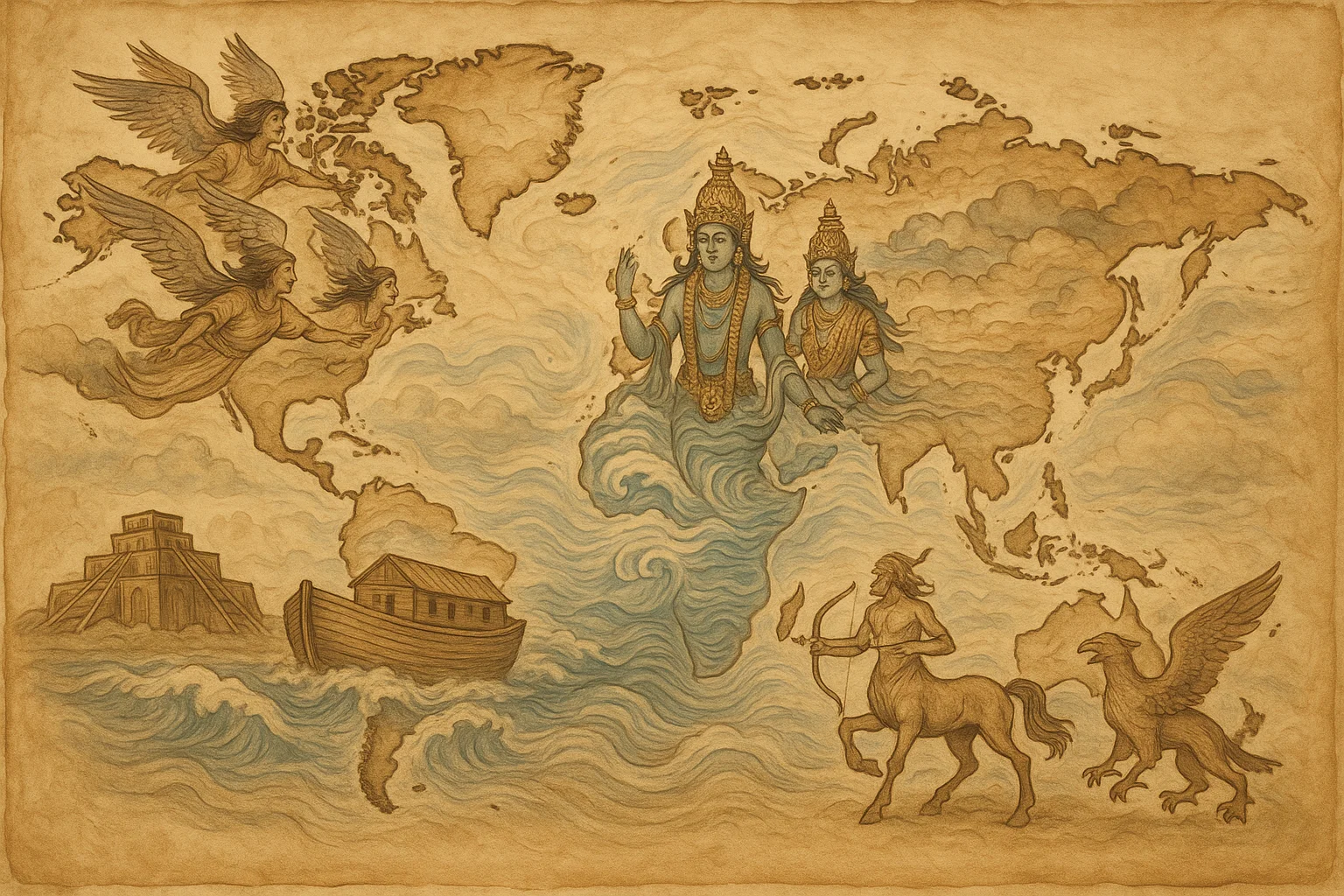
He noticed that across cultures separated by geography, language, and thousands of years of history shared remarkably similar religious imagery. Stories of sacrifice, death and rebirth, the wise old man, the great mother, the flood, the divine child, the hero's journey—these symbolic patterns appear with astonishing consistency.
Jung concluded that these similarities could not simply be dismissed as coincidence or cultural borrowing. Rather, they reflected universal structures within the human psyche itself, what he famously called the archetypes of the collective unconscious. Religion, in this sense, was not merely something human beings invented. It was one of the primary ways these deeper psychological structures expressed themselves.
His clinical work reinforced this conclusion.
Jung observed that many of his patients—particularly those in the second half of life—were not suffering solely from anxiety or depression in the conventional sense. Beneath their symptoms lay a deeper crisis: a loss of meaning, purpose, and orientation. He would later write that among all his patients over the age of thirty-five, there was not one whose deepest problem was not, in one way or another, the problem of finding a religious outlook on life. This did not mean that every patient needed to join a church or adopt a particular creed. Rather, he observed that many psychological disorders emerged when individuals lost any meaningful relationship to something greater than themselves.
For Jung, genuine healing often required more than insight into childhood experiences or unconscious conflicts. It required the discovery—or rediscovery—of a framework capable of giving suffering meaning..
In his own personal accounts, Jung describes God as "one of the most certain and immediate of experiences," and elsewhere writes of how he stood "alone before God." These are not the words of someone advancing a philosophical argument. They are the words of someone describing an experience that, for him, carried an overwhelming psychological certainty.
Whether God exists independently of the human mind remained, for Jung, a metaphysical question beyond the reach of psychology. But one conclusion seemed unavoidable. Wherever human beings have encountered what they experience as the sacred, lives have been transformed. Entire civilizations have been built around these encounters. Art, law, morality, ritual, and identity have all emerged from them.
For Jung, religion was therefore not a relic of humanity's primitive past, nor merely a collection of inherited beliefs. It was one of the deepest expressions of the psyche itself—a living encounter that has shaped human consciousness since the beginning of history.
Why the Psyche Needs a Transcendent Centre
The conscious mind is not the whole of the person.
Beneath conscious awareness lies the unconscious—a vast psychological reality containing forgotten memories, repressed emotions, instincts, symbolic images, and universal patterns that shape behaviour in ways we often fail to recognise. Much of what we think, feel, and do is influenced by forces operating beyond conscious awareness.
The task of psychological development, therefore, is to establish a meaningful relationship between the conscious and the unconscious. This is where one of Jung's most important concepts emerges: the transcendent function.
It describes the psychological process through which opposing elements within the personality—conscious and unconscious, reason and emotion, order and instinct—are brought into dialogue. Out of the tension between these opposites, a new and more integrated attitude can emerge.
For Jung, genuine transformation does not occur by suppressing conflict, but by confronting it.
The individual does not become whole by eliminating one side of their nature. Wholeness is achieved by integrating what has previously been divided.
This is why Jung believed psychology could never be reduced to the simple removal of symptoms.
He proposed that the therapist's task is not simply to remove present difficulties, but to help the individual discover the mental and moral attitude required to confront what emerges from the unconscious.
The unconscious is not simply a storehouse of forgotten memories waiting to be analysed. It presents demands. It confronts the individual with uncomfortable truths, hidden motives, neglected responsibilities, and aspects of the personality that the ego would often prefer to ignore.
To encounter the unconscious honestly requires humility, courage, and responsibility.
In this sense, morality is not merely a social code imposed from outside. It becomes a psychological necessity. Without responsibility, there can be no genuine confrontation with the unconscious. Without honesty, there can be no integration. Without freedom, there can be no meaningful moral choice.
This is why Jung repeatedly insists that individuation—the lifelong process of becoming psychologically whole—is inseparable from ethical development.
A person organised entirely around immediate pleasure, comfort, or the avoidance of suffering remains psychologically centred upon the ego. Every decision is measured by personal gratification. Difficult truths are avoided, responsibility is postponed, and uncomfortable aspects of the personality remain buried beneath the surface.
By contrast, a person whose life is organised around meaning and responsibility possesses a centre of gravity beyond immediate impulse. Short-term desires can be sacrificed for long-term purpose. Suffering can be endured because it is understood within a larger framework. The individual is no longer governed solely by instinct or circumstance, but by a principle capable of ordering the whole personality. Jung saw this distinction repeatedly in his clinical practice.
Many patients arrived seeking relief from anxiety, depression, or inner conflict. Yet beneath these symptoms there often lay a deeper fragmentation—a life lacking coherence, direction, or purpose.
Analysis alone could reveal unconscious patterns, but insight by itself was often insufficient.
Healing required the gradual integration of previously divided aspects of the personality into a more unified whole. It required the discovery of a centre capable of orienting the individual beyond the competing impulses of the ego.
A transcendent frame of reference provides a point of orientation beyond immediate emotion, social pressure, or personal desire. It enables the individual to judge themselves by something greater than their own preferences, creating the conditions for genuine self-examination and transformation.
Without such a centre, the personality risks becoming fragmented, pulled in different directions by instinct, impulse, fear, and external influence.
With it, the possibility of psychological integration begins to emerge.
The psyche, Jung believed, is not simply seeking happiness.
It is seeking wholeness.
And wholeness requires a centre that transcends the ego itself.
When God is Removed, What Takes His Place?
If Jung believed that the human psyche requires a transcendent centre, then what happens when that centre is lost? The modern assumption has often been that as societies become more scientific and secular, religion gradually fades away. Jung believed this assumption was profoundly mistaken.
For Jung, religion is not simply a collection of beliefs or institutions that can be discarded when they become intellectually unfashionable. It expresses what he regarded as a fundamental function of the human psyche: the need to orient one's life around something experienced as ultimate.
This is why Jung argued that the disappearance of religion does not eliminate the religious impulse itself. It merely changes its direction.
The psychological need remains exactly the same. The object of devotion changes.
Human beings continue to organise themselves around something greater than the individual. If that "something" is no longer God, it may become the nation, political ideology, economic systems, race or countless other forms of collective meaning.
The form changes.
The psychological function remains.
This observation became one of Jung's greatest concerns as he watched the political upheavals of the twentieth century. The rise of totalitarian regimes convinced him that modern society had not become less religious. Rather, it had unconsciously transferred religious devotion from the transcendent to the political.
Jung warned that as modern society becomes increasingly organised around large institutions and mass movements, the individual gradually loses their capacity for independent moral judgement. Personal conscience is replaced by collective identity. Responsibility is transferred from the individual to the organisation. The crowd begins to think on behalf of the person.
It is within this context that Jung made the observation that: "The State has taken the place of God."
Jung is not arguing against government itself, nor is he advocating for theocracy. His concern is that whenever the transcendent centre of the personality is removed, another authority inevitably assumes that position.
History provided Jung with powerful examples of this process.
He witnessed the rise of National Socialism in Germany and the consolidation of Soviet Communism, two systems that demanded an almost religious devotion to the collective. Both presented themselves as comprehensive explanations of reality. Both promised redemption through political transformation. Both subordinated the individual conscience to the interests of the State.
For Jung, these were not merely political phenomena.
They revealed something fundamental about the human psyche.
When individuals cease to orient themselves toward a transcendent moral order, they become increasingly susceptible to ideologies that promise certainty, identity, and purpose.
This tendency is not confined to twentieth-century totalitarianism.
The psychological mechanism remains visible wherever individuals surrender their deepest moral convictions to collective identities. Consumerism can become an organising principle around which life revolves. Celebrity culture can elevate individuals into objects of devotion.
Political movements can begin to demand absolute loyalty rather than rational disagreement. Even personal identity itself can become the ultimate source of meaning. The specific object is less important than the underlying process.
The psyche continues to seek an ultimate centre. Jung therefore believed that the real danger facing modern society was not secularism in itself. It was the illusion that human beings can exist without transcendence. Because if the transcendent is denied, the need for transcendence does not vanish.
It returns in another form. Often one far more dangerous than the religious traditions it sought to replace. This is why Jung insisted that the health of a society ultimately depends upon the psychological maturity of the individuals who compose it.
No institution, no ideology, and no political system can substitute for an individual conscience capable of confronting truth, accepting responsibility, and resisting the seductive pull of the collective. For Jung, the struggle was never fundamentally between religion and politics.
It was between an individual whose life is ordered around a transcendent centre and an individual whose deepest loyalties have been absorbed by the crowd.